
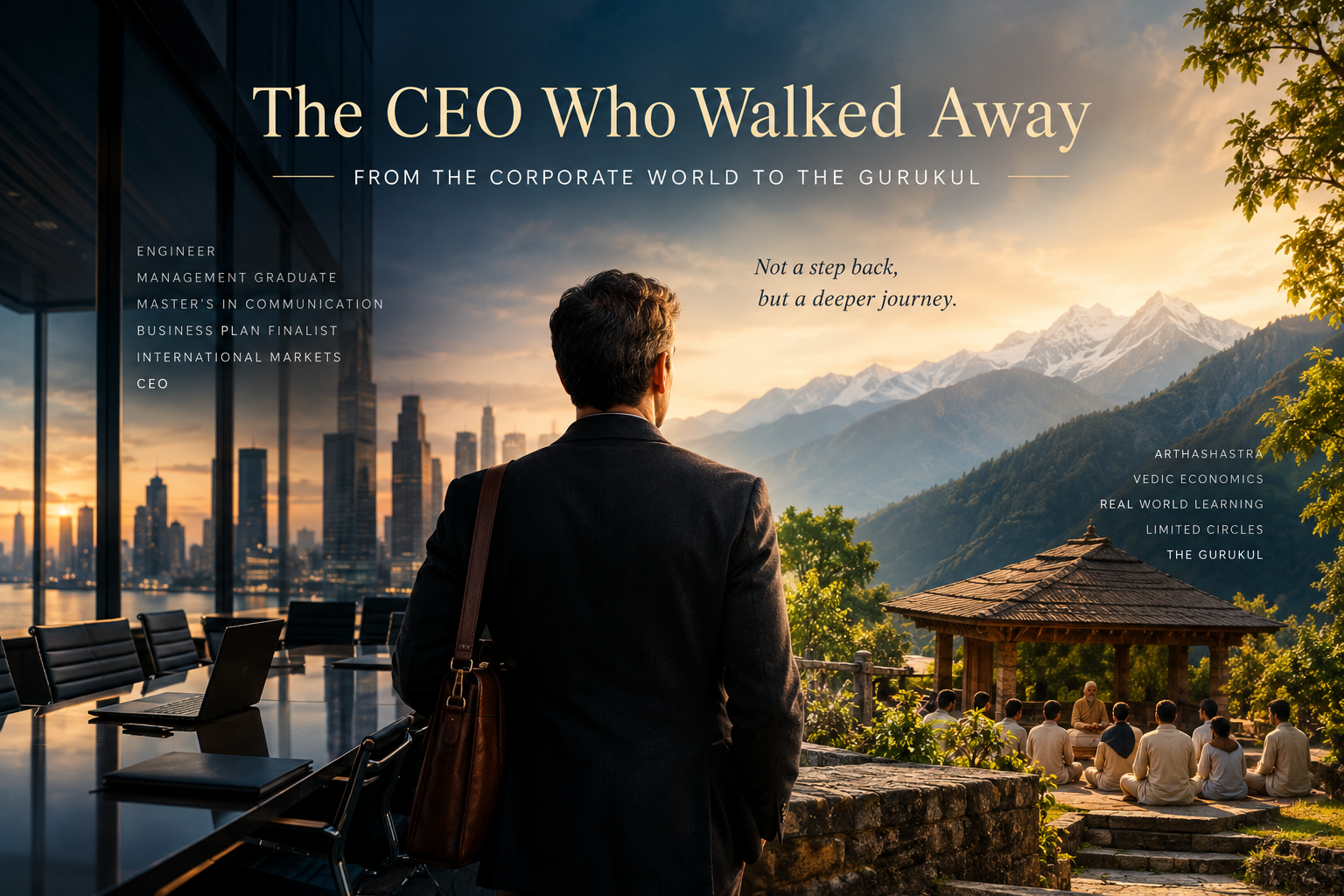
The CEO Who Walked Away
There are decisions that change a career.
And then there are decisions that change the meaning of a career.
Prof. Aryan had already reached a point that most professionals spend decades pursuing.
He had the education.
The international exposure.
The business experience.
The boardroom.
And eventually, the position of Chief Executive Officer of a Marine and Infrastructure Development firm.
He had worked across Asia, Europe and the United States.
He had studied engineering, management and communication.
He had been a three-time business-plan finalist at international universities.
By conventional standards, there was little left to prove.
And then he walked away.
Not to another corporation.
Not to another executive position.
Not to build another conventional business.
He chose a Gurukul.
The Question Behind the Decision
The corporate world teaches you to move quickly.
Analyse.
Forecast.
Compete.
Allocate capital.
Manage people.
Take risks.
Make decisions.
But after years inside that world, Prof. Aryan began looking at something deeper.
What makes one decision better than another?
Why do two people, with access to the same information, make completely different decisions?
Why do some opportunities appear obvious only after they have passed?
Why does timing sometimes matter more than intelligence?
And why do conventional institutions teach people so much about information—but so little about judgment?
These questions gradually became more important than the next corporate title.
Before the Gurukul
His journey was never confined to a single discipline.
He began with engineering.
Engineering develops an understanding of systems.
He moved into management.
Management introduces the complexity of organisations, resources and decisions.
He pursued a Master's in Communication.
Communication reveals another dimension of leadership—the human dimension.
Then came international business exposure.
Working across Asia, Europe and the USA, he encountered different economies, cultures, businesses and ways of thinking.
Along the way, his business ideas were recognised as finalists three times in business-plan competitions at international universities.
And eventually came the CEO role.
The boardroom became his classroom.
The Last Corporate Assignment
His final corporate assignment was as Chief Executive Officer of a Marine and Infrastructure Development firm.
At that level, decisions carry consequences.
Capital has consequences.
Timing has consequences.
People have consequences.
A CEO learns quickly that a spreadsheet can tell you what has happened.
It does not always tell you what is about to happen.
That distinction became increasingly important to Prof. Aryan.
The longer he worked with businesses and decision-makers, the more he became interested in the principles beneath the visible numbers.
Time.
Cycles.
Human behaviour.
Resources.
Nature.
Decision-making.
And eventually, a much older body of knowledge began to attract his attention.
The Path Backward
In a world obsessed with moving forward, Prof. Aryan began looking backward.
Not backward into nostalgia.
Backward into knowledge.
Into the Indian intellectual traditions that existed long before modern management schools, business degrees and financial institutions.
The Arthashastra tradition offered a different way of looking at economics, resources, governance, strategy and human behaviour.
This was not about replacing modern knowledge.
It was about asking whether something had been forgotten.
Could ancient principles and modern experience be examined together?
Could economics be understood beyond textbooks?
Could business be studied as a living system rather than merely a collection of formulas?
Could learning happen through experience rather than only through instruction?
These questions eventually led to the Gurukul.
Why Leave the Boardroom?
Perhaps the most interesting part of Prof. Aryan's story is not that he became a CEO.
It is that he decided that being a CEO was not the final destination.
The corporate world had given him access to something extremely valuable:
experience.
The Gurukul gave him the opportunity to transform that experience into something that could be shared.
Instead of managing an organisation, he began focusing on developing people.
Instead of presenting strategies in boardrooms, he began creating environments where people could observe, question and experience.
Instead of simply asking students to learn, the Gurukul asks them to see.
The Gurukul
A Gurukul is not designed to resemble a corporate training room.
There is no obsession with collecting certificates.
No race to complete another syllabus.
No promise that knowledge alone will transform a person.
The philosophy is different.
Live. Observe. Question. Experience. Reflect. Apply.
The environment matters.
Silence matters.
Discipline matters.
Conversation matters.
The people you learn with matter.
And sometimes, stepping away from the familiar world is necessary to see that world clearly.
This is why the Gurukul is not simply another educational institution for Prof. Aryan.
It is an environment for deeper learning.
From CEO to Professor
The title changed.
The environment changed.
But the fundamental responsibility remained the same.
Decision-making.
A CEO makes decisions affecting an organisation.
A professor influences the way people think.
The first manages resources.
The second develops judgment.
Prof. Aryan chose the latter.
His corporate experience became part of his teaching—not as theory, but as lived experience.
Engineering.
Management.
Communication.
International business.
Corporate leadership.
CEO experience.
And the study of Vedic knowledge.
Different worlds.
One journey.
The Private Nature of the Gurukul
The Gurukul is not designed for everyone.
Perhaps that is inevitable.
Deep learning requires time.
It requires attention.
It requires curiosity.
And sometimes, it requires leaving behind the noise of ordinary life.
The people who enter the Gurukul are not necessarily looking for another course.
They may already have degrees.
Businesses.
Capital.
Experience.
Professional success.
What they are looking for can be much harder to define.
Perspective.
Clarity.
Judgment.
A different way of seeing.
That is where the Gurukul begins.
A Different Definition of Success
The modern world often measures success by accumulation.
A bigger company.
A larger portfolio.
A higher designation.
A bigger office.
More capital.
More influence.
Prof. Aryan's journey asks a quieter question:
What if success is not only about how much you accumulate, but about how deeply you understand?
Perhaps that is why the journey from CEO to Gurukul is significant.
He did not leave the corporate world because he had failed to reach its highest levels.
He left after experiencing them.
And he chose to explore what lies beyond them.
The Man Who Walked Away
There is something unusual about someone who has already reached the boardroom voluntarily choosing the path of the Gurukul.
It is not an obvious career move.
It does not follow the conventional ladder.
It does not fit neatly into a résumé.
And perhaps that is precisely why it is worth understanding.
Prof. Aryan did not leave the corporate world to escape success.
He left because he wanted to explore a different definition of it.
From engineering to management.
From communication to international business.
From boardrooms across continents to the CEO's chair.
And finally—
from the corporate world to the Gurukul.
The journey is not about leaving one world behind.
It is about bringing the experience of that world into another.
And perhaps the most interesting chapter of Prof. Aryan's career began after he had already achieved what most people spend their careers trying to achieve.
The CEO walked away.
The Gurukul began.
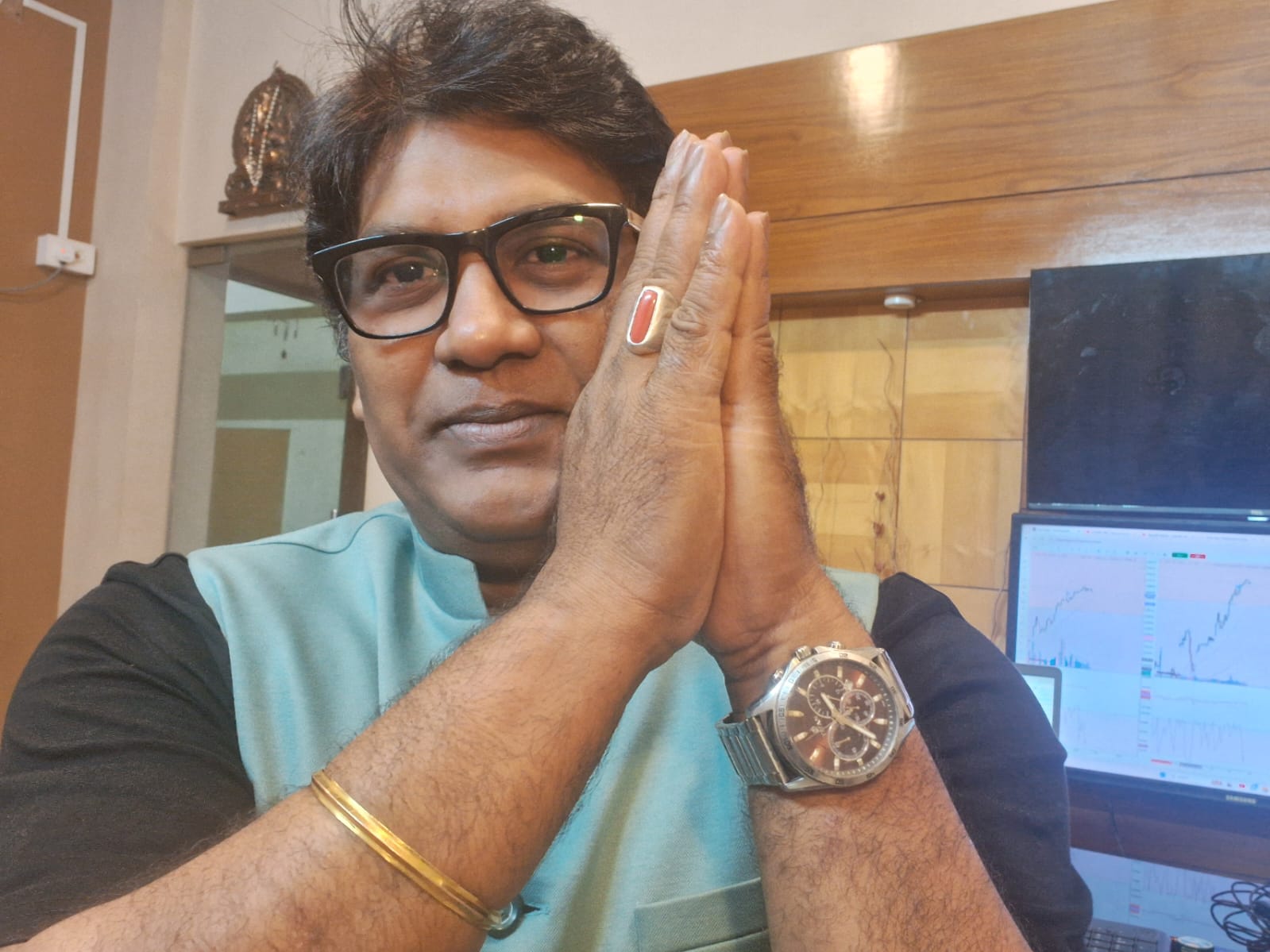
Aryan
Founder, Arthashastra Gurukul
An economics school of thought derived from modern economics, & ancient Aryan works with investors to develop interpretative clarity — how to read uncertainty, identify phases, and avoid costly decision errors.
The mentorship reflects his personal thinking process. There are no recorded courses and no delegated teaching.